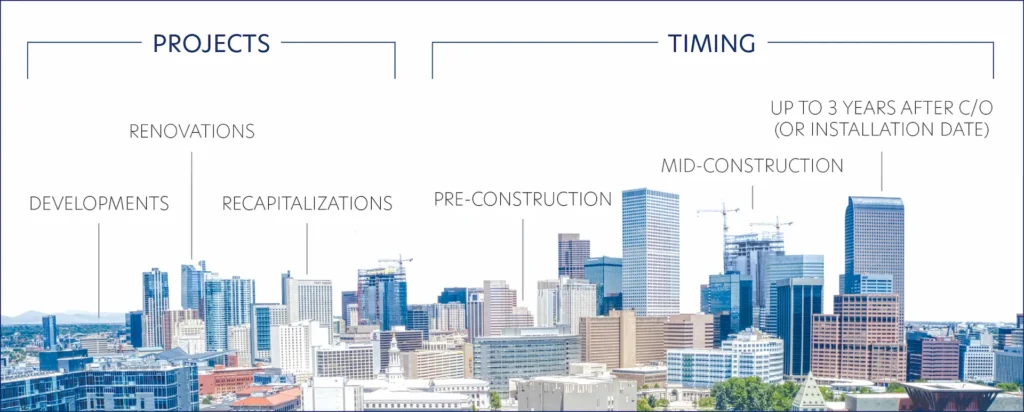

 Over the past several years, Commercial Property Assessed Clean Energy (C-PACE) has quietly moved from a niche tool to a mainstream part of the commercial real estate capital stack, becoming the standard for capital stacks for developments, renovations, and refinancing. C-PACE programs are now active or in development in 41 states plus Washington, D.C. and the US Virgin Islands, with new or updated legislation in places like Georgia, New Mexico, New Jersey, North Carolina, Idaho, Massachusetts, and New York.
C-PACE is long-tenor, fixed-rate financing that is assessed against the real estate and collected as a property-tax line item. It is not mezzanine and it is not preferred equity; it is an asset-backed, passive, tax-lien-priority structured finance product. Get the details of the structure.
Q: C-PACE financing is a go-to source of capital for borrowers. What factors are driving this?
First, there’s a healthy amount of real estate activity in the market, but banks continue to offer reduced leverage which can make projects harder to finance.
Second, interest rates always play a pivotal role. No matter where rates are, C-PACE financing offers access to long-term, low-cost capital. The ability for a project to lock in low-cost rates for 20-30 years without refinance risk gives a lot of project owners the stability they are looking for. Having said that, C-PACE also works as a short- and medium-term option, offering the flexibility many developers need to cover lease-up or bridge to other long-term options.
Third, C-PACE offers flexibility. The structure works with simple or complex capital stacks, it is fully assumable in the event of a sale, and it is prepayable (subject to a step-down prepayment premium). It is available for development, renovation, and recapitalizations.
- Development/Redevelopment: replace expensive debt alternatives, add accretive leverage to overcome low LTC lending, lower WACC with delayed draw custom funding schedule of up to 24 months (for funding greater than $10M), use alongside EB5, HTC, NMTC, TIF, OZ, brownfield grants, and more.
- Renovation/Gut Rehab: avoid second-lien debt options, leverage long-term amortization periods, transfer C-PACE assessment to new owner upon sale, preserve internal funds for other uses
- Refinancing: cover cost overruns, fund interest reserves, reshuffle a capital stack
Q: C-PACE has become a vehicle for refinancing existing properties. How is a refinance via C-PACE structured?
There are a lot of ways to structure a C-PACE recapitalization. We’ve used it to partially pay down senior debt and restructure the capital stack, fund interest reserves, help properties reach stabilization, and cover cost overruns.
One of the most common uses for C-PACE has been refinancing with the goal of extending a loan to allow more time for a project to reach stabilization. In this scenario, developers can refinance a portion of senior debt, or, in some cases, all of the senior debt, with C-PACE financing. Using C-PACE in this way allows for a pending maturity on a still stabilizing property to become less of an issue with more breathing room for lease up to stabilization.
Projects can be refinanced up to 3 years after Certificate of Occupancy or installation date, although this can vary by C-PACE program. Ask your Originator about the guidelines in your area.
Q: Over 400 lenders have consented to C-PACE. What has driven the acceptance?
C-PACE is a relatively “new” product, compared to traditional mortgages that have been around for centuries.
With that said, as C-PACE has grown to a multi-billion dollar industry, senior lenders see it as a tool to help clients complete projects. Many senior lenders see C-PACE as a way to assist clients and grow their book of business. If you are a lender, PACE Equity Finance has a lender partnership program that fuels our Total Debt Solution offering.
Q: Does C-PACE work for larger projects, such as multi-phase developments?
The growth in the number of C-PACE funded projects is growing along with the average funding size. C-PACE is a powerful financing tool that works just as well for big, complex projects as it does for smaller ones. The core features of C-PACE — fixed rate, non-recourse, low-cost, flexible structure — makes sense for any size projects.
PACE Equity Finance is a balance sheet lender backed by a $26+ billion balance sheet; we have the ability to fund deals of any size.