



Brief overview:
Lump-sum C-PACE disbursements are traditionally done at closing, so interest begins to accrue at closing on the full funding amount. PACE Equity Finance uses Delayed Draws with scheduled funding during the construction period to address this issue for projects with $10 million or more C-PACE funding. We distribute C-PACE capital when you need it during construction milestones. Interest accrues only on drawn funds, reducing capitalized interest expense and improving overall project economics.
On a recent C-PACE-funded senior housing project, the Delayed Draw structure reduced projected capitalized interest by 44% when the total interest cost was reduced from $3.6M to $2.0M.
CRE developers want to improve capital efficiency by lowering the weighted average cost of capital (WACC), increasing internal rates of return (IRR), and reducing unnecessary interest carried during construction. C-PACE financing solves these challenges with its low-cost, flexible structures – including the tailored distribution of draws to match the capital needs during construction or Delayed Draws.
Rather than disbursing the entire C-PACE allocation at closing, Delayed Draw C-PACE structures distribute capital over time (up to 24 months) according to a project’s construction schedule (tailored funding schedules). The result is a financing structure that better serves how capital is actually used during construction while significantly reducing capitalized interest costs.
Insights in this article were from a recent interview with Andrew Freter, Director of Originations, on how Delayed Draws are changing the economics of commercial development financing.
Traditional Lump-Sum C-PACE Financing
Historically, C-PACE transactions have been funded as a lump-sum disbursement at closing. For developers, that structure creates a disconnect between when capital is available and when it is actually needed.
In this scenario, a borrower could close on a $10 million C-PACE financing package and begin accruing interest on the full amount immediately — even if only a fraction of the project costs had been incurred during the early stages of construction.
Delayed Draw Schedules Introduced a Construction-Oriented Capital Structure
PACE Equity Finance developed its Delayed Draw structure to solve this issue for C-PACE projects of more than $10 million. Rather than funding the entire C-PACE allocation upfront, the financing is distributed according to a customized funding schedule outlined at closing to align with the construction timeline.
The structure functions similarly to a traditional construction loan while preserving the long-term, fixed-rate, non-recourse benefits of C-PACE financing.
Andrew Freter summarized the process like this:
“Developers complete a single closing, the financing terms are locked upfront, the capital commitment is established at closing, and the draw schedule decides future disbursements over the construction period. This significantly reduces counterpart risk for borrowers while improving certainty of execution across the broader capital stack.”
As projects progress through excavation, framing, mechanical installation, and final buildout phases, developers can access capital when needed instead of carrying interest expense on idle funds.
The result is lower interest carry, reduced capitalized interest, and improved overall capital efficiency.
Delayed Draws Reflect the Continued Evolution of C-PACE Financing
Delayed Draws represent a continued execution of improved C-PACE financing flexibility. More and more, sponsors are leveraging C-PACE for all the right reasons – including its flexibility and applications across the building life cycle. It supports real-world construction scenarios while improving long-term project economics.
Speaking further on its flexibility, Christine Rauch, Director of Asset Management, explains:
“Construction is a fluid and dynamic process with a lot of aspects to consider, such as subcontractor scheduling, on-site material management, and weather. A draw schedule that aligns with construction milestones allows clients to better manage resources, helps with coordination across teams and keeps the project moving forward.”
PACE Equity Finance allows construction draws to be scheduled over a 24 month period, according to milestone schedules. The structure allows sponsors to coordinate capital deployment alongside senior construction lenders.
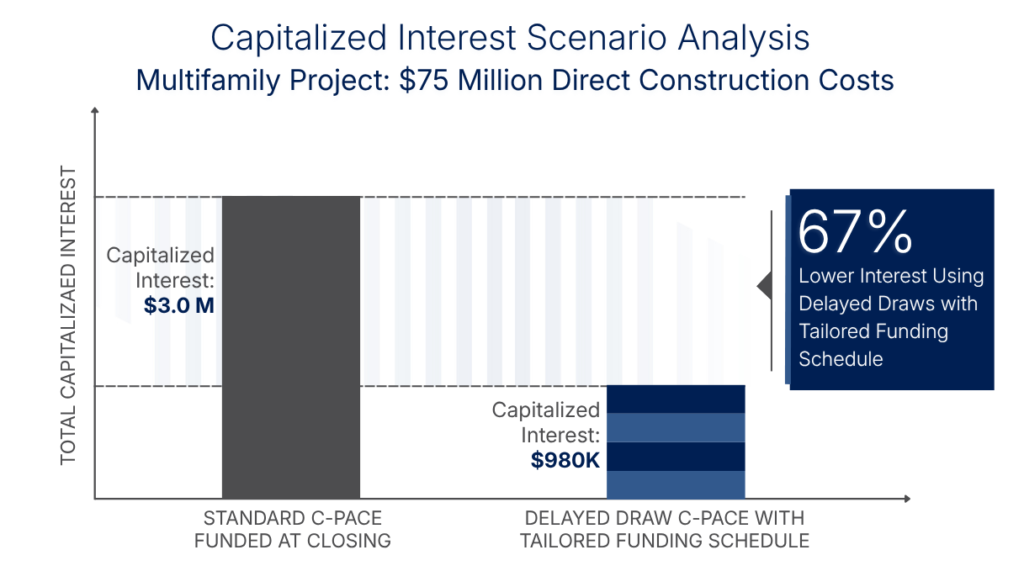
In another recent case study from PACE Equity Finance, a recent multifamily transaction demonstrated how capitalized interest costs can change under a Delayed Draw structure:
“On a $27 million C-PACE allocation within a roughly $75 million multifamily development, the use of Delayed Draws reduced projected capitalized interest from approximately $3 million to roughly $980,000. That is a reduction of more than 67% in projected capitalized interest expense.”
Better Capital Efficiency Through C-PACE Financing
Delayed Draws are a prime example of how C-PACE financing is evolving alongside modern construction and development practices.
PACE Equity Finance continues to advance flexible C-PACE financing solutions designed to help developers navigate increasingly complex financing environments with greater certainty.
Whether evaluating a new construction project, recapitalization strategy, or integrated senior debt + C-PACE structure, working with an experienced financing partner can play a critical role in optimizing long-term project performance.
Interested in learning how Delayed Draw C-PACE financing fits into your capital stack? One of our originators is here to help.