



How Smart Capital Is Reshaping Hospitality: The Energy Efficiency Arbitrage
The most sophisticated hospitality operators have figured out something their competitors haven’t: energy efficiency isn’t a sustainability checkbox — it’s a margin play.
In an industry where operating costs are relentless and guest expectations keep climbing, the developers pulling ahead aren’t just building better hotels. They’re engineering smarter capital stacks. And at the center of that strategy is a financing instrument that is rewiring how the lodging sector funds itself: Commercial Property Assessed Clean Energy financing, or C-PACE.
The Cost Structure Problem — and the Capital Solution
Hotel operators face a structural squeeze. Labor costs are sticky, utility bills keep climbing, and guests expect more for every dollar they spend. Meanwhile, traditional lenders remain conservative, forcing developers to either overequitize projects or leave value-add upgrades on the table.
C-PACE cuts through that constraint. By providing long-term, fixed-rate, non-recourse capital, for which the funding basis is utility-impacting building elements — HVAC, electrical, lighting, plumbing, resiliency, envelope improvements — lets operators fund the upgrades that directly impact their operating cost base without burning through liquidity or diluting equity returns.
The math is straightforward: lower utility costs flow directly to NOI. Better systems mean lower utility costs, fewer maintenance emergencies, reduced capital expenditure surprises, and tighter operational control. That’s not a green story. That’s a yield story.
Stacking Capital Like a Pro
What separates top-tier hospitality developers today is capital stack sophistication. C-PACE doesn’t replace senior debt or equity — it complements them. Layered intelligently alongside conventional financing and tax credits, C-PACE fills the gap that has historically forced developers to either scale back scope or accept equity dilution.
PACE Equity Finance has deployed over $1 billion across over 200 commercial projects, with measurable results that go well beyond carbon metrics. Operators are seeing real reductions in per-key operating costs, stronger asset valuations, and improved debt coverage — outcomes that make lenders and investors pay attention.
The Guest Experience Dividend
Here’s what often gets lost in the sustainability conversation: upgraded building systems don’t just cut costs — they directly improve the guest experience. Modern HVAC systems mean consistent, comfortable room temperatures without the rattling and unpredictability of aging equipment. Upgraded lighting creates the ambiance guests photograph and review. Efficient plumbing means reliable hot water and water pressure that guests take for granted — until it fails.
When the back-of-house runs better, the front-of-house shines. Fewer maintenance disruptions, more consistent room quality, and a physical product that competes at a higher tier — all funded through capital that pays for itself through operational savings over time.
Proof Points That Matter
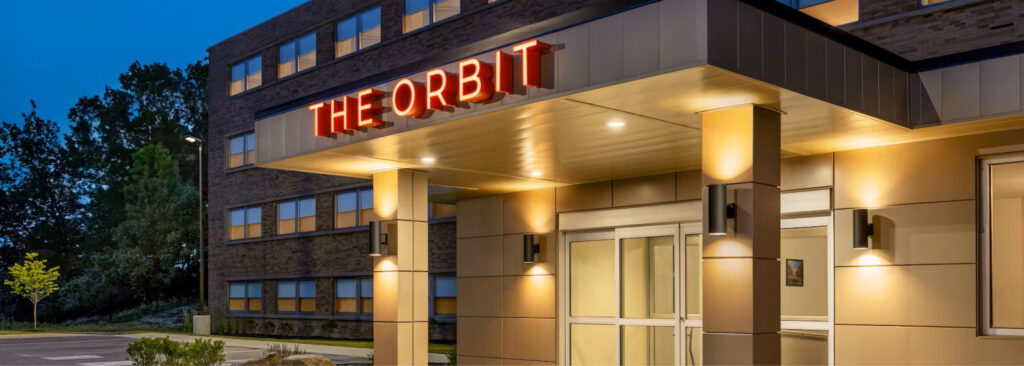
Consider The Orbit Hotel by Wyndham — a 54-unit boutique property redeveloped from 1960s-era NASA housing in Cleveland. C-PACE financing funded a comprehensive systems overhaul: electrical, lighting, HVAC, and plumbing. The result is a property that operates with meaningfully lower energy intensity than its original build, with annual carbon savings of 4,800 metric tons — and, critically, operating economics that support a viable, competitive boutique hospitality business.
In New Mexico, a hospitality retreat center put $10.2 million of C-PACE financing to work, representing 32% of its total capital stack on a post-construction refinancing. The move recaptured equity for the sponsor, locked in long-term fixed-rate non-recourse debt, and delivered 600 metric tons in annual carbon savings — a transaction that would have looked like a purely financial play even without the sustainability wrapper.

The Edge Goes to Those Who Move First
Innovative financing products like C-PACE capital introduces another layer of advantage: access to low-cost financing rates. Even incremental sustainability upgrades can qualify a project for market-leading pricing.
The Bottom Line
The lodging operators winning on returns right now aren’t waiting for energy costs to stabilize or interest rates to fall. They’re using smart financing structures to reduce their operating cost base today, improve their guest product, and strengthen the underlying asset — all at once.
C-PACE isn’t a sustainability gesture. For the operators who understand it, it’s a competitive weapon.