

For years, resiliency sat at the edge of commercial real estate conversations. It was a design aspiration, often cut when budgets tightened. That has changed. Physical risk now shows up directly in insurance costs, lender requirements, and valuation. Owners who treat resiliency as core infrastructure are better positioned to protect both their assets and their returns.
The cost of standing still is rising
JLL data shows that commercial real estate premiums across the U.S. rose 88% between 2020 and 2025, reflecting the increase in billion-dollar weather and climate disasters which reached their third highest levels in 2025 (Source: Climate Central). To secure favorable terms, owners may now need to show property-level protections such as flood barriers, storm shutters, better drainage, and fire-resistant materials.
C-PACE lets owners finance these protections directly. For example, in Florida PACE Equity Finance has financed wind and water resiliency measures on coastal projects, where hardening against storms is central to protecting the asset.
Resiliency is being priced in
Capital markets are adjusting as well. Participants at the 2026 ULI Resilience Summit noted that climate risk is pushing owners, lenders, and insurers to reconsider how they value resilient buildings. They also described climate risk being built into acquisitions, capital planning, and underwriting. A building that can stay operational, insurable, and leased through a severe event holds its value better than one that cannot.
In western states, including Idaho, Washington, California, and Nevada, seismic improvements are an important part of the budget and are an eligible C-PACE expense. On those projects, resiliency can account for approximately 25% of the funding amount (Source: PACE Equity Finance).
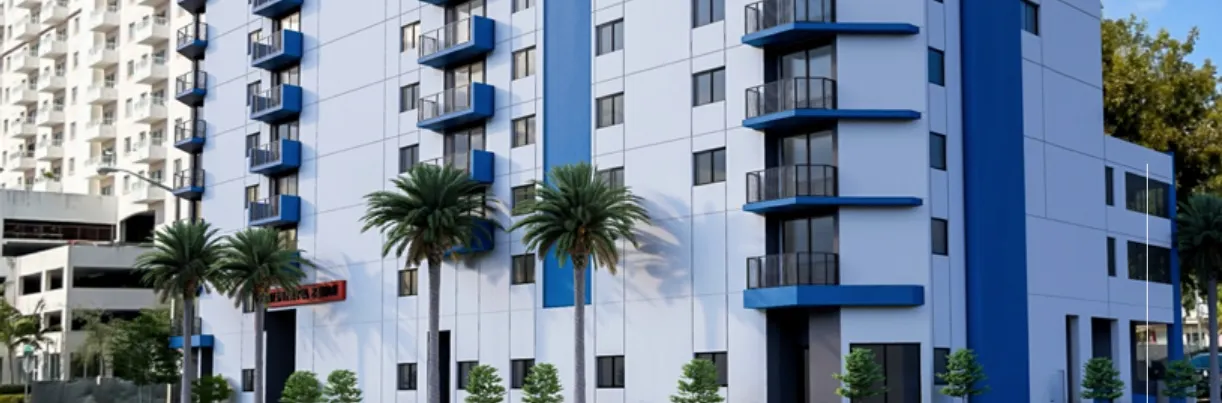
Crenshaw Lofts in Los Angeles shows how this works in practice. The $104 million mixed-use development brings 195 apartments and ground-floor retail to a federal Opportunity Zone along the Crenshaw-LAX Transit Corridor. PACE Equity Finance provided $12 million in C-PACE financing to complete the capital stack, and seismic improvements were among the funded measures, alongside building envelope, HVAC, electrical and lighting, and plumbing. The 30-year, fixed-rate financing made up 11% of the stack. It worked alongside the project’s Opportunity Zone structure and let the sponsor, SoLa Impact, avoid higher-cost mezzanine debt.
C-PACE is expanding what can be financed
C-PACE is now available in 40 states plus Washington, D.C. and the U.S. Virgin Islands. More than two-thirds of states with C-PACE programs support resiliency measures and that share continues to grow. Colorado’s updated program guide, effective April 2026, explicitly adds resiliency improvements such as backup power, storm hardening, flood mitigation, seismic upgrades, and wildfire resistance. New Jersey has opened its program to ground-up new construction, with resiliency measures among the eligible improvements.
More states are becoming C-PACER (Commercial Property Assessed Clean Energy and Resiliency) states. As they do, PACE Equity Finance expects roughly 20% of its funding to go toward resiliency measures in construction budgets.
Financing the resilient building
For most sponsors, the question is not whether resiliency pays off. It is how to fund the upfront cost without adding equity or straining the senior loan. C-PACE is long-tenor, fixed-rate financing assessed against the real estate and collected as a property-tax line item. It is non-recourse and non-dilutive, and it is fully assumable if the property sells. It typically covers up to 35% of the capital stack for new construction and 50 to 100% for renovations.
PACE Equity Finance is a direct balance-sheet C-PACE lender. Since 2014, it has funded $1B+ in C-PACE financing across 200+ transactions. Approvals happen in-house, with no reliance on syndication, which gives sponsors certainty of execution. The firm’s structuring, engineering, underwriting, and servicing teams support each project from underwriting through post-close.
Extreme weather is now a permanent part of how commercial real estate is valued and underwritten. The owners who plan for it now will be best positioned when it arrives.